Oskar Eriksson
Let the Right One InOskar Eriksson is a bullied schoolboy whose attempts to assert himself are treated as transgressions, even when he knows the answer in class. Across these glimpses, he shifts from seeking recognition to finding agency in actions he can choose for himself, while his bond with Eli offers both intimacy and an uncertain way out. At the end, a police officer remembers Oskar as the boy who answered a question about heroin, but Oskar is missing after two youths are killed at the school pool.
Identity and the Need to Be Seen
In class 6B, a policeman asks about the contents of a bag during a lesson on drugs. Oskar knows the answer and puts his hand up despite knowing, as the narration emphasizes, that this is a risky thing for him to do. The gesture is modest, but its importance to him is not: he wants the policeman to notice him and confirm that he is right. Knowledge becomes a means of claiming attention in a room where he is otherwise accustomed to being overlooked or targeted.
That classroom moment later acquires an afterlife in Gunnar Holmberg’s memory. Three weeks afterward, while investigating two deaths at the school pool, Holmberg recalls that Oskar was the boy who had answered his question about heroin. He had expected Oskar to come out to the police car and imagined taking him for a ride, perhaps to encourage his confidence. Oskar never appeared. The recollection makes the earlier raised hand more than a passing classroom detail: it is the small act through which Oskar briefly became visible to an adult who later wonders where he has gone.
Bullying and the Limits of Appeasement
The response to Oskar’s classroom participation is not approval from his classmates but renewed threat. In a bathroom stall, he hears attackers battering the door and considers whether to unlock it before they become angrier. Their abuse is framed as a punishment for his existence: they can supply explanations based on his appearance, but the deeper offense, in his understanding, is simply that he has made himself noticeable. The pressure to disappear is therefore present even in the moments when he tries to speak up.
Oskar expects that the boys may force his head into a toilet as part of their familiar ritual. He has learned to regard the end of an assault as a relief, whatever they claim to be doing. Yet when the lock gives way and Micke Siskov appears with a triumphant smile, Oskar recognizes that the encounter is not following the usual pattern. The shift matters because his survival has depended on anticipating what his tormentors will do; this time, recognition does not make the situation safe, but it marks the moment when the old expectation fails.
Chosen Action and the Knife
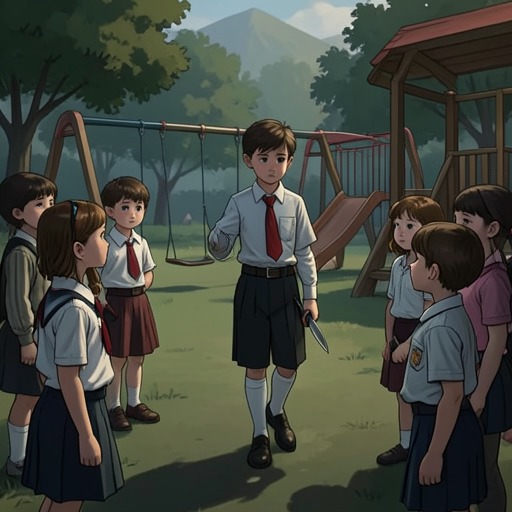
Away from school, Oskar’s relation to fear changes. After leaving the forest, he finds that a place that had seemed threatening now feels like refuge. He walks home without anxiety about the coming day, then sits at the edge of the sandbox in the apartment courtyard to settle himself. The sequence contrasts the forest’s earlier association with enemies against the calm he now experiences there, without suggesting that the world around him has become harmless.
He plans to get a better knife, one with a guard so he will not cut himself, and resolves to repeat what he has done. The detail makes his new sense of control concrete: it is not an abstract declaration of courage but a practical adjustment to an action he intends to undertake again. His private judgment that it was a good game carries an unsettling double meaning. The language of play gives him a way to frame an act connected with bloodshed, while his preparation shows that the experience has become something he can choose to revisit rather than only endure.
Eli and Intimacy
Oskar’s relationship with Eli also makes recognition feel dangerous. When Eli takes his hand and touches his wound, Oskar sees an older, harder presence beneath her appearance. He cannot be certain what he sees in the darkness behind her, but the encounter alters his perception of Eli: the familiar companion is also someone whose nature exceeds what he thought he understood. Eli’s warning that he must not let them do it places a demand on him, though this moment alone does not explain its full meaning.
Later, Oskar transfers boxes from Eli’s balcony to his own while there is still daylight and Eli is washing. When Eli emerges, the wounds on her back have healed, and she is slightly intoxicated from alcohol in the blood. They lie together and hold each other. Oskar tells her what happened to him in the subway, and Eli apologizes for having started it. Their exchange joins care to consequence: Oskar offers the account of what he has endured, and Eli acknowledges a connection between her actions and his experience. Their closeness does not erase danger; instead, the scene lets apology, physical comfort, and the aftermath of violence occupy the same relationship.
The Cube and Departure
Oskar buys a Rubik’s Cube with the twenty kronor he has, paying nineteen kronor for the paint-colored object. The kick he receives outside the store is customary, though worse than usual. Once away from the shop, he runs to the parking lot, where two cars shield him as he opens the package. The Cube is heavier than his imitation, its sections slide smoothly, and he keeps it in his coat pocket so that he can feel its weight. He thinks of it as a good-bye present, giving the purchase a significance beyond its use as a puzzle: it becomes something to hold as he prepares to leave.
After Oskar brings the boxes across from Eli’s balcony, the two remain together in bed, holding each other. At the same time, his mother watches television coverage of their building, while Oskar can see the same scene from the window. The contrast places private preparation beside public attention: the building is visible as news, but the choices and attachments shaping Oskar’s departure remain within the apartment.
Disappearance and Narrative Role
The closing police investigation returns to the school, where Holmberg is trying to organize his notes after a day spent examining the crime scene and speaking with students. Two youths have been killed at the pool, and a third boy has disappeared. Holmberg identifies that missing boy as Oskar, connecting him to the earlier classroom encounter. His memory is personal but incomplete: he remembers Oskar’s answer and the confidence he hoped to encourage, not what has happened to him since.
That gap preserves the significance of Oskar’s invisibility. In school, he raised his hand to be noticed; later, the adult who remembers him cannot find him. The supplied scenes trace a boy repeatedly pressed toward silence, yet capable of making choices, seeking closeness, and preparing for departure. His disappearance does not resolve those tensions. It leaves his connection with Eli and his own next step suspended beyond the investigation’s view.